
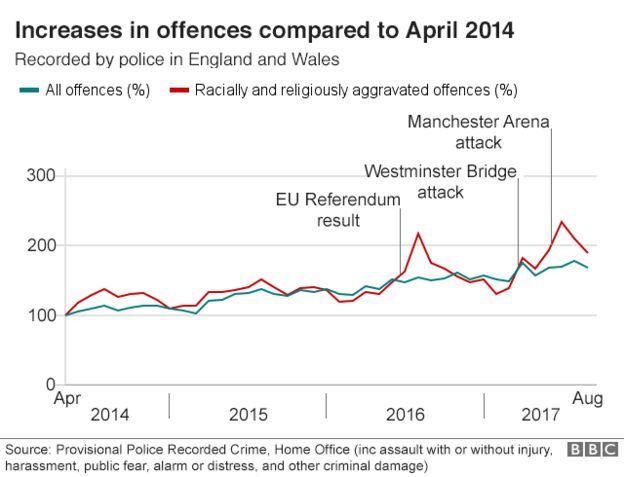
For the scale project, it was important for me to use the typeface in today's date. On talking about it with my peers, I came to the conclusion the 'Boycott Hate' would be appropriate for a large scale poster. As I began to research into this, I was astonished to see the rise in hate crimes in just the past one year, and in just UK and India respectively.
A hate crime is defined as "any criminal offence which is perceived, by the victim or any other person, to be motivated by a hostility or prejudice" based on one of five categories: religion, faith or belief; race, ethnicity or nationality; sexual orientation; disability; or gender identity.
The number of hate crimes in England and Wales has increased by 29%, according to Home Office statistics.
There were 80,393 offences in 2016-17, compared with 62,518 in 2015-16 - the largest increase since the Home Office began recording figures in 2011-12.
In 2016-17:
62,685 (78%) were race hate crimes
9,157 (11%) were sexual orientation hate crimes
5,949 (7%) were religious hate crimes
5,558 (7%) were disability hate crimes
1,248 (2%) were transgender hate crimes
Some crimes were recorded as having more than one motivating factor.
To develop this project further, I decided to make it into a fictional campaign against hate crimes. Although due to lack of time, I could only make the poster publications and an acrylic wall hanger. Had I had more time, I would have tried to make more items of the campaign such as badges, t-shirts, etc and maybe even a website design.
Increase in Hate Crimes
Paris '68
The Paris 1968 unrest began with a series of student occupation protests against capitalism, consumerism, American imperialism and traditional institutions, values and order. It then spread to factories with strikes involving 11 million workers, more than 22% of the total population of France at the time, for two continuous weeks.
While their fellow students engaged in pitched battles with the police and millions of workers went on general strike, students at the École des Beaux-Arts in 1968 occupied the printing studios and converted them into the uprising's very own propaganda machine. Many of the resulting posters have become icons of political design. The posters display different styles but the individual designers were never credited – they were the work of the collective. What they had in common was an economy of expression: single colours printed on newssheet gifted by the striking newspapers, bold forms and provocative slogans.
I feel the posters printed during this protest is relevant for my project due to its nature of raising its voice against something and also the method by which it was produced. I used photo emulsion screen printing to print the publication posters for my fictional campaign. These posters were simple, spread the message and were usually made within a day - so it included only the details that were really required. I wished to do the same for my publication posters- the publication has the information that is required to be communicated but at the same time it opens up to a beautiful poster which is supposed to be an incentive for the receivers to keep it with them.
Paris '68
Sister Corita Kent's Poster
Sister Corita Kent's Poster
Hope to Nope - Black Lives Matter Quilt
Black Lives Matter was formed in the US in 2013. This quilt was made to raise funds for a campaign for justice in anither fatal white - on - black shooting and to support progrssive black electoral candidates.
Paris '68 Posters
Sister Corita Kent
Sister Mary Corita Kent was an American Roman Catholic religious sister, artist, and educator. She taught herself how to silkscreen screenprint. Kent's work was unapologetically positive, drawing inspiration from scripture, advertising and the streets of Los Angeles. Her prints featured phrases and graphic patterns that cribbed from cultural references and juxtaposed high and low, techniques seen in the work of contemporary artists from Andy Warhol to Shepard Fairey. She initially began with abstract artwork which did receive criticism. Her work then began to shift, addressing issues like civil rights and the Vietnam War and also had the pop culture aesthetic to them.
I feel her work really relates to mine for a few reasons- She used screen printing to produce her posters and I have used the same process as well. She often had typography in her posters and I do to as I wanted to explore typography through this process. Moreover, the messages she spread through her posters were of love, peace, and war and anti-racism. She wanted her work to be an "expression of joy". Even the posters I've made is to spread the message of decreasing hate crimes and depicts celebration of love.
Sister Corita Kent
Hope to Nope - Pride Propaganda subversions of Russian Posters
In 2013 Putin, the Russian President, outlawed the 'propaganda of non-traditional sexual relations' - effectively banning LGBT rights.Tumblr site, Pride propaganda, responded to this by sharing a series of posters that was widely shared on social media.
Paris '68 Posters
Sister Corita Kent's Poster
Hope to Nope Exhibition
The Hope to Nope exhibition at the Design Museum had some excellent examples of posters and items that relate to the topic of my research. A few of them related to hate crimes and it was interesting to see how different designer approached the same topic.
Hope to Nope - Tolerance Posters
Tolerance is a touring exhibition of posters organised by Mirko Ilic. These posters have been travelling to different cities with the poster of a local designer being added at each stop. These posters provide an international response to the current state of the world and the role of design in promoting peace.
SOURCE
Websites:
http://www.bbc.co.uk/news/uk-41648865
https://en.wikipedia.org/wiki/May_1968_events_in_France#Slogans_and_graffiti
https://www.theguardian.com/artanddesign/2011/may/23/beauty-in-street-posters-protest
https://www.youtube.com/watch?v=tivdlh2mhIU
https://www.youtube.com/watch?v=YCtcD9CfMOI
http://www.art-for-a-change.com/Paris/paris.html
https://gizmodo.com/how-a-screenprinting-nun-changed-the-course-of-modern-a-1412576274
http://thatsinkedup.blogspot.co.uk/2016/09/sr-corita-kent-and-her-messages-of-love.html
Exhibitions:
Hope to Nope, Design Museum.